
Download our Code of Behaviour, here.
North Monastery Coeducational Secondary School
Code of Behaviour to Support Learning
“Good behaviour is a necessary condition for
effective teaching to take place”
1.0 Mission Statement
“Inspired by the vision of Blessed Edmund Rice, the North Monastery Coeducational Secondary School, in its proud tradition is committed, in partnership with parents, to enabling all members of the school community, to achieve their full potential in a caring Christian community where mutual respect, good order, discipline and positive self-esteem are the values which guide us in our teaching and learning community”.
2.0 Preamble
The Board of Management of the North Monastery Coeducational Secondary School strives to ensure that our school is a place where all stakeholders exist in an atmosphere which is conducive to effective teaching and learning. The Board of Management has a statutory obligation to ensure their employees’ safety, health and welfare at work as far as is reasonably practicable. It is also a school where students and teachers co-exist in an atmosphere of mutual respect and safety. Health and safety is of paramount importance for the school community insofar as is reasonably practicable.
Good order and discipline are vital ingredients which facilitate teaching and learning of the highest quality and underpins every classroom setting. Ensuring we reach these high standards is an achievable goal once respect for human dignity is a core value for all stakeholders.
The school accepts that our students come from varying cultural and social backgrounds. We also understand that our students have different aspirations and abilities. The school strives to ensure each student reaches their potential and as a consequence the services of the Student Support Team, the Learning Support Teacher, the Guidance Counsellor and the Behaviour for Learning Teacher support the work of teachers in the classroom to facilitate the enhancement of the student experience.
This Code of Behaviour is the set of programmes, practices and procedures that together form the school’s plan for helping students in the school to behave and perform well.
We respect and encourage the collaborative role of parents in the implementation of this policy and other connected policies such as the attendance policy, the mobile phone policy, the anti-bullying policy, and any policy on rewards that may be used as an incentive. Students are deemed to have accepted any related policies when they are deemed to have accepted/signed the Code of Behaviour by joining the school.
Closed Circuit Television (CCTV) cameras are used in the school for security, and health and safety.
General Data Protection Regulations (GDPR) are adhered to for this code of behaviour.
Nothing in this code of behaviour excludes any student that has reached the age of 18 years from exercising rights outlined within the Education Acts.
In cases, at the discretion of senior management, where incidents of theft or illegal substances are investigated, the school reserves the right to search lockers or other storage devices.
Permission to park student vehicles, other than bicycles, should be sought from the Principal and appropriate documentation will need to be supplied before a decision is made.
2.1 System of Rewards
It is the policy of the Board of Management of the North Monastery Coeducational Secondary School to acknowledge and reward students who by their demeanour exemplify good behaviour, co-operation, respect and a positive commitment to learning. Positive reinforcement is important and good behaviour both inside and outside of the classroom is acknowledged by both informal and formal means.
A rewards system can create a positive environment in the school because:
- It celebrates and validates achievement, service and effort.
- It highlights students who work very quietly and diligently throughout the school year.
- It is not confined to high achievers. It focuses on every student who is trying to
reach their potential no matter what level they are at in the ability spectrum.
- It acknowledges good and respectful behaviour in the classroom and within the confines of the school campus.
- It acknowledges service to the school in areas such as the Green Flag Initiative,
the Yellow Flag Initiative, Service in the local community, the School Music Initiative, commitment to training and playing on school teams, being a team member in the Young Scientist Competition, representing the school at social, cultural, and educational events.
3.0 The National Educational Welfare Board states or guides towards the following in relation to high standards of behaviour:
3.1 Standards are the means by which the school will:
- Provide clarity for students about the school’s high expectations for their behaviour
- Set goals for students that will guide them in moving towards mature and appropriate behaviour
- Serve as a practical tool for teaching and learning
3.2 Standards of behaviour should reflect values such as:
- Respect for self and others, including our neighbours in the local community
- Kindness and willingness to help others
- Courtesy and good manners
- Fairness
- Readiness to use respectful ways of resolving difficulties and conflict including the use of restorative practices
- Forgiveness
3.3 The standards will describe the commitment that the school expects from students to their own learning and that of their peers. This commitment will include:
- Attending school regularly and punctually
- Doing one’s best in class
- Taking responsibility for one’s work
- Keeping the rules
- Helping to create a safe, positive environment
- Respecting staff
- Respecting other students and their learning
- Participating in school activities
3.4 Standards are also a way of signalling to members of the school community the kinds of behaviours that are not acceptable in the school, for example:
- Behaviour that is hurtful (including bullying, harassment, discrimination, victimisation and intimidation all of which include cyber versions)
- Behaviour that interferes with teaching and learning
- Threats or physical hurt to any person
- Damage to property
- Theft
- Being out of class without permission
4.0 As a practical response to behaviour standards as set out or guided by the NEWB, the Aims of our Code of Behaviour to Support Learning are:
(1) To provide behaviour guidelines which will support each student to develop,
emotionally, intellectually, socially and spiritually.
(2) To emphasise and highlight the promotion of good behaviour.
(3) To create an environment where all partners in our school community feel safe, respected and valued, free from any type of bullying, harassment, discrimination, victimisation, or intimidation, through the use of cyber or other means.
(4) To promote self – esteem, self – discipline and positive relationships.
(5) To create an ordered and respectful environment where pupils and staff can reach their creative and intellectual potential.
(6) To ensure students and parents are aware of the standards of behaviour required from each student for effective teaching to take place.
(7) To highlight how positive and co-operative behaviour is encouraged, acknowledged and rewarded.
(8) To outline the strategies to be initiated when a student contravenes this Code.
5.0 Roles and Responsibilities.
Every member of the school community has a role to play in ensuring the promotion and effective implementation of this Code.
5.1 The Code as it applies to Students
Each student has a duty to their class teacher and their fellow students to behave in a
manner which does not impede the teacher from teaching and their fellow students from learning.
Before specific rules are itemised it should be noted that teachers are in “loco parentis”. As a consequence, they are entitled to be respected by all students in the same way that
parents are respected in the family home. It is absolutely unacceptable that any student will attempt to abuse, harass, intimidate or assault, including by cyber means, any member of staff while he/she is going about his/her daily work. It should also be noted that staff members other than teaching staff are entitled to the same respect and protection.
The following rules as they apply to students will support and underpin this philosophy. They will support good order in the school thereby ensuring students can learn and teachers can teach.
5.2 Classroom and general Behaviour
- A Student should enter the classroom in an orderly manner and sit at their allotted desk if assigned one.
- A student must be in full school uniform.
- Books and equipment essential for effective teaching and learning must be in a student’s possession on entering class. They should be placed on the desk as soon as the student is seated.
- Assigned homework must be produced for each class. If a student does not have their homework completed, then the student is required to have a note from home explaining why the homework has not been attempted or completed. If a student is absent from a class, then it is their responsibility to ensure all relevant homework is completed.
- Students are expected to be cooperative at all times while a class is in session.
- It is a requirement of students that they are respectful at all times to members of staff both inside and outside the classroom setting. Any student who defies a member of staff or who acts in a disrespectful manner will be deemed to have breached this Code and may be withdrawn from class by management. A meeting may be sought with parents and a suspension may follow. A repeat of this type of behaviour may result in the student being referred to the Board of Management where options up to and including expulsion will be considered.
- Offensive language is absolutely forbidden within the school.
- Incidents of bullying, name calling, harassment, discrimination, victimisation or intimidation by cyber or other means will be considered a serious breach of this Code. The Anti-Bullying policy and this Code of Behaviour may be invoked together to address incidents of bullying.
- A student cannot leave the classroom without the permission of the class teacher and must be in class when expected unless permission has been given otherwise.
- Students are not allowed to eat or drink in the classroom or corridors unless given permission for appropriate reasons by senior management.
- Chewing gum is forbidden in the school building and campus.
- Before a student leaves a classroom they must check the area around the desk for litter. The student must deposit litter in the appropriate bin BEFORE leaving the classroom.
- All students are required to have a School Journal. The Journal will be used to take down assigned homework, facilitate toilet breaks, facilitate notes from parents to teachers and also from teachers to parents. It must be made available to teachers in the classroom or elsewhere by teachers requesting same.
- Students can only be absent from the classroom for a toilet break when given permission with a signed school journal.
- If a student requires a toilet break due to a medical issue, then a doctors’ note may be required.
- Students must comply with the specific rules and regulations as they apply to specialist areas such as Science Laboratories, Gymnasium, Metalwork and Woodwork rooms, Art room, Computer Room. This is not an exhaustive list.
- Students must assemble quietly outside the classroom door until the teacher allows them to enter or must behave appropriately if assigned base classrooms and are awaiting the next teacher.
- Smoking is absolutely forbidden on the school premises, school grounds, in the vicinity of the school and on all school outings. The term smoking includes vaping.
- Students must comply with the school policy on mobile phones. (See separate connected policy). The use of Yondr pouches or similar pouches is school policy.
- Students are encouraged to pick up litter and expected to if of their own making and to always strive to keep the school and the grounds clean and tidy. (Refer to Green Flag Policy)
- Bringing illegal substances into the school for personal use of for distribution is absolutely forbidden. A student who is found in possession of these substances will be referred immediately to the Board of Management. Gardaí will also be informed.
5.3 Respect for International Students
- All students are expected to adhere to our acceptance of diversity
- Students are expected to recognise and value differences between individuals as a consequence of being born into and living their early years in another country.
- All students have a duty to promote an atmosphere of inclusiveness in our school.
- Any student who by their behaviour does not live up to the aims and objectives of our acceptance of diversity will be dealt with through the Sanction Process linked to this Code of Behaviour.
5.4 Appearance and School Uniform.
The school uniform identifies students with the school. We expect students to wear the uniform with respect and pride. The uniform is also an important element of our safety strategy as students are easily identifiable within the school, when they are on school trips or in the school yard. Parents/guardians are asked to cooperate fully to ensure that their child has a complete uniform. (Exceptional circumstances can be dealt with in confidence between parents and school management). All items of uniform should have a student’s name attached. This will enable an item to be returned to a student in the event of the item being mislaid.
The Code as it applies to the uniform is as follows:
- The uniform consists of
- Grey Pants
- School tie (not mandatory with round neck jumper)
- Pale blue shirt
- Navy round neck jumper with School Crest OR
- Navy V-neck jumper with School Crest (School tie must be worn)
- Plain, flat, black footwear
- Navy puffer jacket with School Crest attached.
- School tracksuit on PE days and school trips only
The following are not permitted:
- Boots
- Any type of facial jewellery, earrings unless within the Code direction i.e. The guideline for a single stud earring is at senior management discretion.
- Hand Jewellery
- Snood
- The wearing of any type of badge or symbol that may be considered discriminatory or offensive to others.
- Sweat shirts, Hoodies, Non-school tracksuits or Sports Jackets.
- Nail extensions
5.5 Student’s responsibility re books and equipment.
- Students are not allowed to store bags/books/equipment in corridors or under If a locker is provided, they can be stored there. Adequate time is given to students to access lockers in the morning and afternoon before classes start. Appropriate materials, including school journals must be removed from lockers each day before going home to allow assigned homework and study to be completed at home.
- Under the present Department of Education Book Scheme – The books are not the property of the student. They are the property of the school authorities. If lost or otherwise needing replacement, the school reserves the right to ask for payment for replacement of any school property.
- Books should have a student’s name on the inside cover to ensure a book can be returned in the event of it being found.
- It is not appropriate for a student to disrupt a class in order to retrieve a book or equipment from outside the classroom. Thus all necessary books and equipment must be in the student’s possession before class starts. If the retrieval of books or equipment is necessary, this will only be allowed with express permission of the teacher in question.
- Students must have the required equipment for PE. This Includes sports shirt, school tracksuit, and runners.
5.6 Student’s responsibility to the Environment
- All students are expected to support the principles underpinning our Green School Policy. This is a separate policy and should be read in conjunction with this Code.
- Recycling bins must be used in the classroom, corridors and yards.
- Waste bins are also provided at strategic points around the school and should be used by students
- A student should never leave a classroom until they have checked that the area around their desk is free from litter. Any litter collected should be deposited in the appropriate bin BEFORE the student leaves the classroom.
- Chewing gum is extremely difficult to remove if it comes in contact with school furniture, the school floor, a student’s clothes or hair. Students are therefore not allowed to chew gum in the building or in the campus.
- It is absolutely forbidden for a student to write or draw on a desk, wall, locker or other school property.
Graffiti on walls or desks etc. makes a very negative visual impact on individual classrooms and on the school building and environment in general.
- When students are granted the use of a locker, they are expected to respect this part of school property. It is absolutely forbidden for a student to write, draw or place any stickers on a locker. Refusal to use a locker appropriately can lead to the removal of the privilege of using a locker permanently. The decision on the removal of this privilege is at the discretion of senior management.
5.7 Student’s responsibility in relation to Mobile Phone Usage
Parents and students are asked to reference the Mobile Phone Acceptable Use Policy which should be read in conjunction with this Code of Behaviour. Yondr or similar pouches are used in the school and must be used by students unless sanctioned otherwise by senior management.
5.8 Students responsibility in relation to the School Campus
- Students are not allowed to encroach on the school gardens at any time.
- For health and safety reasons students must confine themselves to their designated yard at break times. This is to ensure all students are supervised when in the yard. 1st years remain in school for big lunch.
- When leaving the school building and exiting the main school gate students must confine themselves to the footpaths adjacent to the avenue.
- Students must not congregate between the Fair Hill gate and the steps leading down to the door opposite the Fair Hill entrance. This means that once a student enters the Fair Hill gate they must proceed immediately to the designated yard or entrance door. Similarly, when time to go home, students following this route must move immediately from the campus through the Fair Hill gate.
5.9 Students responsibility in relation to Attendance and Punctuality.
There is a direct link between a student’s attendance and their academic attainment. If a student is to reach their academic potential, then they must be in school on time every day for the full duration of the day unless agreed with school authorities. A student who is habitually late for school is disrupting the work ethic of the class and the teacher. They are also developing bad habits which will undermine them in, for example Third Level and/or an employment environment.
- The school day begins at 8.55am and finishes at 3.45pm.
- A parent/guardian must write a note in a student’s journal if:
- The student is late for school and has a valid reason
- The student must leave the school during the school day
- The student has been absent the previous day or number of days.
- Any student who arrives later than the first class in the morning or afternoon must inform the office secretary BEFORE going to class.
- Family holidays arranged during school time seriously undermine a student’s progress. As a school we are not in favour of students being taken out of school for the purpose of a family holiday.
- The school is obliged by law to inform the Education Welfare Services if a student has accumulated 20 absent days. The attendance monitoring and actions pyramid which is part of this present code, illustrates the general format taken for absences.
- Parents will be informed if a student is persistently late without a valid reason.
- A student who accumulates three such lates may be put on detention after school. The date of this detention will be at the discretion of the Deputy Principal or Year Head and parents/guardians will be informed by detention slip.
- Subsequent lates up to a maximum of 6 may result in the student being put on further detention for each late. Parents/guardians will be informed by detention slip. Any lates after this and the student may receive a Letter 2. If so, Parent/guardians will be asked to meet with the Deputy Principal and if necessary the relevant Year Head to seek a resolution to the problem of the student arriving late for class.
For each subsequent late a student may be required to attend detention on a Wednesday for a period of 2 hours. This sanction will be applied for a maximum of three lates. If the student is unable to resolve the issue at that stage they will be issued with further sanctions, for example internal suspension from class.
Students miss out on teaching and learning when they are taken out for appointments or holidays. They also miss out on homework. As a consequence, appointments where possible should be made outside school hours,
- Students who need to leave the school during the school day to visit the doctor, dentist etc. must have a note in their journal signed by a parent/guardian. This note must state the reason for the absence, the time the student will be leaving the school and the approximate time of their return. This note must be presented to either the Year Head, or in their absence, Deputy Principal or Principal for signing BEFORE the student signs out at the office. The school secretary will check that a member of Management has signed the note before registering this on the appropriate attendance software.
5.10 The Code as it applies to School Examinations.
- Students are required to be seated in their allocated Examination Centre at least 5 minutes before the start of an examination.
- Students who are consistently late for examinations may not be allowed to enter a centre and may be sent home, in consultation with parents/guardians, if in the opinion of senior management there is no acceptable reason for being late.
- Students must have in their possession all equipment required for the examination.
- Students are required to be in full school uniform for the duration of the examinations.
- A student may be removed from a centre and sent home, in consultation with parents/guardians, if their behaviour, in the opinion of senior management, is such that the ability of other students to concentrate on their work is compromised as a consequence of the behaviour. The student will be allowed back to complete their examinations once the management receives a letter from a parent or guardian confirming that the student will comply with school rules as they apply to examinations.
- A student who is found to be cheating in an examination will be removed from the centre and sent home, in consultation with parents/guardians, for the remainder of the examination. They will not receive a result for the relevant subject.
6.0(a) The role of Management and Teachers in relation to the
implementation of the Code
Teachers use: their professional expertise in understanding the links between behaviour and learning, their experience of what works to help students to behave well, and their knowledge of the school and of the school community.
However, despite the best efforts of our teachers and management, inappropriate behaviour does happen. Minor breaches have a disruptive influence on the classroom setting and in time can lead to the undermining of the learning environment.
Serious misbehaviour can have more long lasting consequences. It can result in the undermining of morale and affect, in a very negative way, the educational life chances of students. It can cause stress and anxiety for students and staff which is a most undesirable situation for co-operative students and hard-working staff to endure.
The management of the North Monastery Coeducational Secondary School is very conscious of the need to maintain a classroom and general school environment which supports the learning of every student and facilitates teachers to carry on effective instruction.
When a student begins to display challenging behaviour in the classroom a series of interventions will be introduced in an attempt to get the student back on track.
The following individual interventions will form the basis for a whole school strategy to address inappropriate behaviour by a student:
6.0(b) Implementation of the Code of Behaviour – Summary
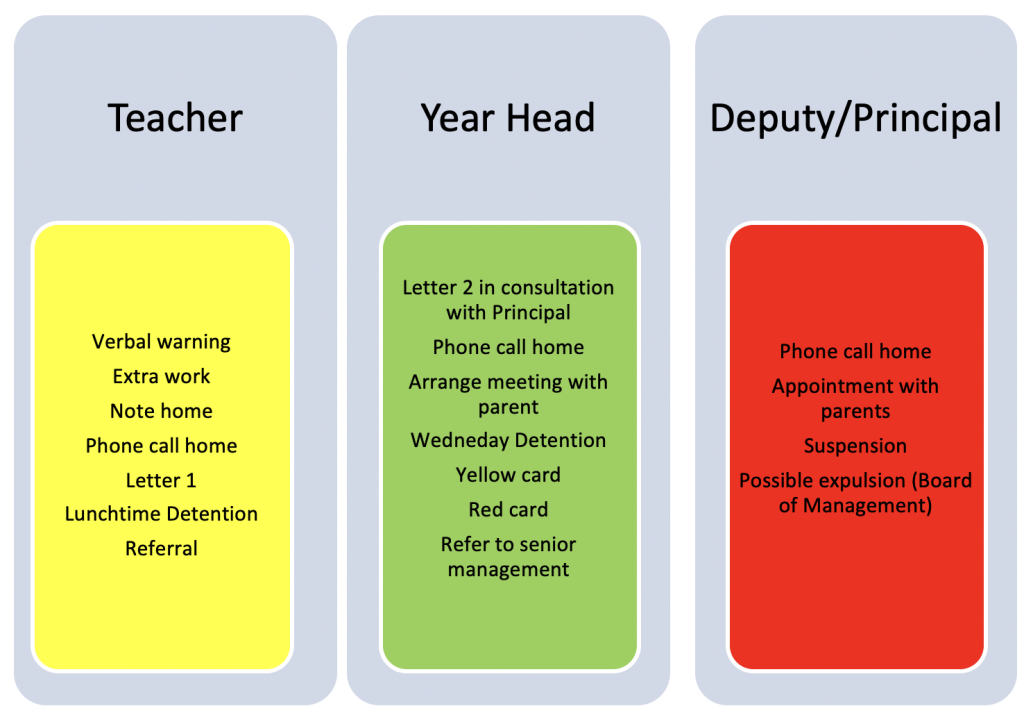
Procedures possible at different levels (not exhaustive)
| Stage 1 | Stage 2 | Stage 3 |
| Teacher | Year Head | Deputy Principal/Principal |
| Verbal warning | Letter 2 in consultation with Principal | Phone call home |
| Extra work | Phone call home | Appointment with parents |
| Note to parents in journal/app | Appointment with parents | Suspension |
| Phone call home | Wednesday Detention | Possible expulsion by Board of Management |
| Letter 1 | Yellow card | |
| Lunchtime detention | Red card | |
| Behaviour referral on VSware | Refer to senior management |
6.1 Subject Teacher
The subject teacher is the front line source of support for students. As the leader of learning in the classroom and someone in an established relationship of trust, the subject teacher will have a strong influence on students’ behaviour.
The subject teacher will deal with routine incidents of misbehaviour through classroom management strategies thus minimising the need for other interventions. For minor breaches of the Code the subject teacher can;
- Issue a student with a Letter 1 to inform parent(s)/guardian(s) for the following reasons:
- No homework
- No materials
- No extra work
- No PE gear.
- Other failures to conform accepted by senior management
- If a letter 1 is not complied with, issue the student with a Letter 2 in consultation with the Year Head/Deputy Principal/Principal. The Letter 2 will outline the nature of the problem and an invitation to the parent/guardian to meet with the subject teacher.
The teacher may be accompanied by the appropriate Year Head or the Deputy Principal at the meeting. This meeting will act as an early warning sign for a parent and student and ensures both the school and the parents are co-operating in the interests of the student.
This meeting will plot a course of intervention/s to facilitate the amelioration of the student’s behaviour. Interventions may include some or all of the following; Guidance Counsellor, Behaviour for Learning Teacher, Learning Support Teacher.
Once a Behavioural Plan is decided upon the student may be put on a Yellow Close Supervision Card for a period of one week. If a yellow card is issued at management discretion, and at the end of this period the student’s behaviour has improved to the satisfaction of management and the teaching staff then the Yellow Card will be withdrawn.
- Alternatively, if at the end of the first Yellow Card period the student’s behaviour has not improved then the card may be reissued, at management discretion, for a further week and/or a meeting may be arranged with the Principal and/or Deputy Principal for the student and their parents/guardians. This meeting will address the continued inability of the student to comply with the Code. This meeting will also map out further interventions if required.
If at the end of any Yellow Card period, not only for letter 1 or letter 2 circumstances, but card(s) issued at the discretion of management for any continuous misbehaviour, and where the behaviour of the student has not improved, and after meeting or contacting parents, the student can be considered for a red card at management discretion. If the red card is unsatisfactory as considered by the Principal, the student may be suspended. On return to school, and after school management has met or made contact with parents/guardians (at management discretion), the student will be expected to improve so as to demonstrate acceptance of the Code of Behaviour. This cycle – yellow card, red card and at the discretion of the Principal at any time, referral to Behaviour for Learning, Learning Support, Counselling, School Completion Programme, a possible suspension – can be followed for 3 (three) similar cycles following which, if improvement is not witnessed by the Principal, the student’s file may be referred to the Board of Management at the discretion of the Principal. If the file is referred to the Board of Management, the Board will discuss all options up to and including expulsion. If not referred, further discussions may be arranged with parents/guardians and/or student and a Letter of Undertaking to behave may be issued, at the discretion of senior management. Failure to follow a Letter of Undertaking may result in referral to the Board of Management at the discretion of the Principal. The Board will discuss all options up to and including expulsion.
The 3 (three) cycles mentioned will be judged by the Principal’s discretion taking all circumstances into account including subject teacher sanctions, year head sanctions and Deputy/Principal’s sanctions to date. It is at the Principal’s discretion, taking all circumstances into account, to refer any student to the Board of Management for breaches of the Code of Behaviour as outlined within this Code of Behaviour, even without a 3 (three) cycle instance. Sanctions up to and including expulsion will be considered by the Board of Management.

Yellow cards and red cards should be handed into the main office at the end of the school day and collected at the start of the next school day to avoid misplacing or losing the card. Cards are the responsibility of the student until handed in and must be treated with respect to document the attempts at behaviour improvement.
6.2 Issuing of Referral Notice.
- A Referral Notice, on paper, on the behaviour tab on VSWARE or other computer packages, is a very important link in the continuity chain of behaviour management. A referral notice, if written in any circumstance should document the incident clearly and if appropriate, attempts at behaviour improvement, for example sanctions, contact with parents and any other relevant details, and be stored in a student’s file appropriately. If a subject teacher feels that a referral should be written and needs support to deal with the issue, the referral notice should be escalated to the Year Head for appropriate sanction if deemed necessary. If considered appropriate the referral can be escalated to Senior Management by teachers in consultation with the appropriate year head or by a year head who documents the referral. In any escalation, details of what was tried at a previous stage, either by subject teacher or year head, needs to be documented if appropriate. This does not discount the possibility of a Senior Management decision in more serious cases.
- A referral notice is normally issued initially by teachers generally to record other than minor incidents ofmisbehaviour in a classroom setting, in the school campus or outside the confines of the school grounds. However, any inappropriate behaviour can be documented.
- It records the nature of the infraction and facilitates the recording of action taken by the teacher and/or management to address the issues highlighted in the Referral.
- The Referral Notice will form part of the Student File sent to the Board of Management in serious cases of studentmisbehaviour.
6.3 Whole class Behaviour Performance Sheet.
- On occasions it may be necessary for a class to be monitored by all subject teachers.
- This will consist of a teacher awarding a grade of Behaviour/Performance at the end of a class. The grade will be in Likert Scale Format.
7.0 The role of Parents/Guardians as it applies to the Code
Parents/Guardians have a vital role to play in the implementation of the Code. In very practical ways they can support their child in their learning by adhering to the following;
- Ensuring the student’s attendance and punctuality is of the highest standard.
- When referring to attendance of a student in school The Education Welfare Act outlines – where a student is absent from the school at which they are registered during part of a school day, or for a school day, or more than a school day, the parent/guardian of the student shall in accordance with procedures specified in the Code of Behaviour prepared by the school under Section 23 of the Act NOTIFY THE PRINCIPAL OF THE SCHOOL OF THE REASONS FOR THE STUDENT’S ABSENCE.
- An absence must be recorded in the student’s Journal with appropriate dates.
- Checking their Homework Journal every night to ensure homework is completed.
- Supporting the student’s learning by ensuring the student abides by our school rules and policies.
- Attending Parent-Teacher meetings and any special appointments when requested.
- Ensuring with the student that they have all the requisite books and materials for every subject, a school journal and a school bag for carrying school materials.
- Ensuring the student attends school every day wearing their full uniform.
- If there is a change in the home circumstances of a student the parent/guardian must inform the school as soon as possible. This includes a bereavement which may upset the student and undermine their ability to concentrate.
- The parent/guardian must inform the school if there is a change in a contact number. Correct information is vital with regard to a contact number particularly in the event of an emergency.
8.0 (a) The Code as it applies to Suspensions
Any suspension is defined as “requiring a student to absent themselves from the school for a specified period of time”. During a period of suspension, the student retains their place in the school. A suspension may be followed by referral to the Board of Management for sanction up to and including expulsion.
The Board of Management delegates authority to the Principal to suspend a student. In the absence of the Principal authority for suspension will be transferred to the Deputy Principal. Any suspension is at the discretion of senior management in authority to suspend. A letter will issue to parents/guardians in cases of suspension.
Before a student returns from any suspension, a meeting will be held if required, at the discretion of senior management, for the student and a parent/guardian to make sure that the pupil is ready to return and willing to obey the Code of Behaviour of the school going forward. This meeting will be with a member of the senior management team.
A student may be suspended for a number of reasons including:
- If the student’s behaviour has a detrimental effect on the education of other students and the ability of teachers to teach.
- If the student has behaved in a manner which in the opinion of senior management constitutes bullying/harassment/discrimination/victimisation/intimidation or assault of a member of staff.
- If following an investigation, the student is found to be responsible for damaging school property.
- If a student’s behaviour brings the name of the North Monastery Coeducational Secondary School into disrepute.
- If the student in the opinion of senior management following consultation with staff is considered a threat to the safety of students and/or staff.
- If a student is involved in physical fighting while on the school premises /campus.
- Repeated, persistent failure to follow clear and reasonable instructions, after other interventions have failed.
- Refusal to comply with the School Policy on Mobile Phones having been directed to do so by the Principal/ Deputy Principal or teacher.
- Smoking (including vaping) or consuming alcohol, taking or distributing illegal substances on the school premises or grounds or while on a supervised school outing.
- Leaving the school premises without permission during the school day without regard for health and safety implications.
- Inappropriate use of digital media including but not restricted to social media.
- Inappropriate language towards a member of staff.
(b) Immediate Suspension
In exceptional circumstances, the Principal may consider an immediate suspension to be necessary where the continued presence of the student in the school at the time would represent a serious threat to the safety of students and/or staff.
It may be necessary where a student despite warnings and interventions continually undermines the work of students and staff to such an extent that students cannot learn and teachers cannot teach.
It may also be necessary in a case where a student is involved in bullying or harassing a staff member within the confines of the school or on social media. In this instance the continued presence of the student in the school would result in the relevant staff member being unable to function at his/her optimum level of proficiency.
In practice the parent/guardian will be contacted by phone and once contact is made the parent/guardian will be made aware of the nature of the infraction. The parent/guardian will be requested to come to the school as a matter of urgency to meet with senior management. Following this meeting the student will return home with the parent. If the parent is unable to come to the school, the student will be sent home after contact.
The parents/guardians/student will be further contacted by letter which will outline the reasons for the Immediate Suspension and also the process which will be initiated by the school management to address the issue.
There may be a possibility that the Principal may have to refer the student’s file to the Board of Management for sanction up to and including expulsion.
A student may be offered the services of the Guidance Counsellor or other services such as Behaviour for Learning as a support following a return from suspension.
Grounds for immediate Suspension
- Fighting in the school building/campus
- Refusing to comply with a clear and reasonable instruction given by a member of staff which undermines the ability of the teacher to teach and students to learn.
- Directing abusive and threatening language towards a member of staff or a student
- Being threatening or abusive towards a member of staff.
- Setting off the Fire Alarm.
- Posing a health and safety risk to any member of the school community.
- Refusing to hand over their phone in contravention of the Mobile Phone Policy.
- Bullying/Harassment/Discrimination/Victimisation/Intimidation of a student or staff member through the medium of social media.
The grounds listed above may be referred to the Board of Management for consideration of sanction up to and including expulsion.
(c) Automatic Suspension
The Board of Management as part of the school’s policy on sanctions and following consultation with the Principal, parents, teachers and students, have decided that particular named behaviours can incur automatic suspension as a sanction. Fair procedures will apply in these cases.
In addition to the grounds for Immediate Suspension the following infractions can result in an Automatic Suspension;
- Leaving the school during the school day without permission from school management.
- Smoking or vaping in the school building/campus
- Not turning up for detention.
In the case of an Automatic Suspension the parents/guardians/student will receive a letter outlining the reasons for the suspension and the steps which must be followed if the student is to be allowed to return to school.
8.1 (a) Suspension during House Examinations
This should be used only where there is:
- A threat to good order in the conduct of the examination
- A threat to the safety of other students and personnel
- A threat to the right of other students to do their examination in a calm atmosphere.
The sanction will be treated like any other suspension, and the principles and fair procedures governing suspensions will be applied.
(b) State Examinations
It should be noted that a student who in the opinion of the State Examination Supervisor needs to be removed from a centre during the state examinations, may be required to complete further examinations in another school.
The decision to remove the student from the centre will be taken by the Supervisor. He/she will inform the Department of Education and Skills that the student has been removed.
8.2 Implementing a suspension
The Principal will inform the parents/guardians/student in writing of the decision to suspend. The letter will confirm:
- The period of the suspension and the dates on which the suspension will begin and end
- The reasons for the suspension
- The arrangement for the ‘return to school’ support meeting, if required, at the discretion of senior management, including any commitments to be entered into by the student and the parents/guardians.
- The provision for an appeal to the Board of Management
- The provision to appeal to the Patron (where appropriate).
- The right to appeal to the Secretary General of the Department of Education (where appropriate).
9.0 Expulsion
The Board of Management of a recognised Secondary School has the authority to expel a student.
A proposal to expel a student requires serious grounds such as that:
- The student’s behaviour is a persistent cause of significant disruption to the learning of others or the teaching process
- The student’s continued presence in the school constitutes a real and significant threat to safety
- The student is responsible for serious damage to property
- The student behaves in a manner which intentionally or recklessly, seriously interferes with the other’s peace and privacy or causes alarm, distress or harm to another.
9.1 Expulsion for first offence
There may be exceptional circumstances where the Board of Management forms the opinion that a student should be expelled for a first offence. The kinds of behaviour that might result in a proposal to expel on the basis of a single breach of the code might include:
- A serious threat of violence against another student or member of staff
- Actual violence or physical assault
- Supplying illegal drugs to other students in the school
- Sexual assault
- The student behaves in a manner which intentionally or recklessly, interferes with the other’s peace and privacy or causes alarm, distress or harm to another.
9.2 Procedures in respect of expulsion
Where a preliminary assessment of the facts confirms serious misbehaviour that could warrant expulsion, the following steps will include:
- A detailed investigation carried out by the Principal.
- A recommendation to the Board of Management by the Principal.
- Consideration by the Board of Management of the Principal’s recommendation; and the holding of a hearing.
- Following the hearing the Board of Management will state its intention to expel or to recommend some other sanction.
- If the intention is to expel the Board will contact the Education Welfare Officer and outline the reasons for the intended course of action.
- The EWO will arrange for consultations over a period of 20 school days.
- The Board of management may consider it appropriate to suspend a student during this period.
- Where the twenty – day period following notification to the EWO has elapsed, and where the Board of Management remains of the view that the student should be expelled, the Board of Management will formally confirm the decision to expel. Parents will be notified immediately that the expulsion will now proceed. Parents and the student will be informed of their right to appeal and supplied with the standard form on which to lodge an appeal.
APPENDIX 1
The following is the form of the required signed agreement for all students and reflects the code core. However, the Code of Behaviour itself must be taken as the ultimate guide to behaviour in North Monastery Coeducational Secondary School.
Contract of Core Expectations
North Monastery Coeducational Secondary School Code of Behaviour
As a parent/Guardian of __________________________________(or as a student, having reached 18 years of age) I agree to sign this Contract of Core Expectations which underpins the School Code of Behaviour. By signing this contract, I agree to uphold the North Monastery Coeducational Secondary School Code of Behaviour to Support Learning. I have explained the Code to my child and they understand their responsibilities (or I understand the Code and understand my responsibilities) in relation to upholding the Code of Behaviour.
The following expectations provide a basis for reasonable and responsible behaviour in our school. (For students who have reached 18 years, appropriate change in wording will apply e.g. ‘My child’ replaced by ‘I’ and ‘they’ replaced by ’I’). Restorative Practices (RP) may be used where appropriate as judged by senior management.
It is school policy to reward positive behaviour by informal and formal means when deemed appropriate.
- My child will come to school every day for the full day or as otherwise legitimately agreed with the school authorities and arrive on time
This means:
- That they will attend school as appropriate unless it is absolutely unavoidable
- That they will arrive each day at 8.45 and be punctual for all classes.
- That I will ensure lateness is explained by a note in the school journal.
- I will explain all absences in the school journal. I will ensure the dates of their absences are recorded on the note and that the note is signed.
Because
- Time missed is hard to make up.
- Punctuality displays courtesy to their teachers and fellow students and is a life-skill for adulthood and the world of work.
- A student who arrives late for school may distract secretarial staff from their work, disrupts the learning process and can result in the student missing out on vital classwork.
- The school requires a written explanation for absence by a parent/guardian as per Section 18 of the Education Welfare Act 2000.
- My child will come to school in full school uniform, clean and tidy. (Ref 5.4 Code).
This means:
- The uniform as outlined in our Code is worn at all times.
- That my child will only wear the school tracksuit on PE days and on school trips
- That no facial or hand jewellery is worn.
- That the official school jacket is worn when my child is travelling to and from school.
- That my child will not wear hoodies, sports tops, non-school jacket etc. instead of the school jacket in school generally, including classrooms.
Because:
- The school uniform is agreed by the school authorities, the parents and the student’s council.
- It presents a very positive image of the school.
- The school uniform ensures each student presents in the same way every day—regardless of income.
- The absence of prohibited piercings, facial and hand jewellery helps to maintain high standards of health and safety in the school.
- I will ensure my child attends class equipped with the required texts, drawing
equipment, PE gear and other materials required for classwork.
This means
- They will not have to go to their locker during class.
- They will only need to access their locker during appropriate break times.
- They will be prepared for work once they enter the classroom
- They will have their school journal available during class.
Because
- Valuable teaching time is wasted if the student arrives unprepared for class.
- Students walking corridors when classes are in session pose a health and safety risk in the school.
- The availability of the school journal is a valuable communication medium between the home and the school and from teacher to parent. It is also used for toilet break permission.
- A student will find it difficult to participate fully in class if they do not have the requisite materials.
- I will ensure my child will co-operate and participate in class and
have a positive attitude to class, homework and all extra-curricular
activities.
This means:
- That they are respectful to their teachers and classmates at all
times.
- That they listen to their teacher.
- That they do not participate in, or instigate disruptive
behaviour.
- That they hand in completed, assigned homework or assigned extra work, on time.
- That they do not eat or drink in the classroom setting without permission and supervision of school staff.
Because
- In order for students to learn and reach their potential the teacher must be allowed to teach in an atmosphere which is orderly, positive and facilitates the realisation of high expectations.
- Homework enables a student to test their understanding of what has been taught in class. It also reinforces material covered during class.
- I will ensure my child has respect and consideration for their teachers and other school staff, other students and people living in the local community.
This means:
- That they are respectful of all members of the school community.
- That they will not bully, harass, discriminate against, victimise or intimidate any other member of the school community.
- If they witness any of the above that they will support the victim by reporting the incident to a member of staff. Such reporting will protect vulnerable members of the school community.
- Under no circumstances will a student involve themselves in
the physical assault of any member of the school community
whether inside or outside the confines of the school grounds.
- The bullying, harassment, discrimination, victimisation or intimidation of a staff member or student on social media is absolutely forbidden. Transgression of this rule by any student may result in their file being sent for attention to the Board of Management. If sent to the Board, all options up to expulsion will be considered.
- The appropriate use of digital media including but not restricted to social media, must be observed at all times.
- All students should be aware of the rights of people living in our local area.
Because
- Students and staff are entitled to come to school free from the fear of physical assault, bullying, harassment, discrimination, victimisation or intimidation including by cyber means.
- Inappropriate use of digital media including on social media is unacceptable. This includes but is not limited to viewing inappropriate materials, taking videos, pictures or voice recordings without permission, setting up accounts on social media in another’s name.
- People living in our local area are our neighbours. All students should be mindful of the rights of our neighbours to live in our local area free from the fear of harassment or unnecessary disturbance.
- When mutual respect exists in a school it forms a foundation
for a very positive atmosphere of teaching and learning.
- We strive to ensure our school commits to high expectations for all our students. A positive atmosphere facilitates our students reaching those high expectations.
- Negative, aggressive and bullying behaviour directed at fellow students can have an undermining effect on a students’ ability to learn, on their mental health and on their future prospects in life.
- Members of the school community who work in our school to provide for their families have entitlements. One of the most fundamental is that they are entitled to attend their place of work free from the possibility of being bullied, harassed, discriminated against, victimised, intimidated or assaulted. A student who has been taught self – respect and respect for others in the home will not involve themselves in such unacceptable behaviour. However, in a small minority of cases where a student falls below the agreed standards of behaviour the repercussions could impact very seriously on the relevant student’s future in the school.
- I will ensure my child respects the school environment, property and
equipment.
This means:
- They are conscious of the work carried out by our cleaners and
caretaker and supports them by doing their best to keep the school clean of litter.
- That they will support the Green School Policy by using the
appropriate bins.
- Not chewing gum in any part of the building or grounds.
- Eating their lunch in the designated areas.
Because:
- They are part of our collective response to maintaining a clean, safe and pleasant environment.
- All students have a responsibility to ensure we maintain our Green Flag status.
- When chewing gum sticks to the floor of corridors or classrooms it makes removing it very difficult for our cleaners and caretaker. This adds significantly to the workload of our ancillary staff.
- I will ensure my child shows respect for others in the way they speak, in the
language they use and in the way they behave.
This means:
- That they are not aggressive in behaviour or language.
- That they will carry out instructions in a co-operative manner.
- Courtesy, respect, and good manners should be the hallmark of their approach in all their dealings with staff and students.
Because
- When students approach their work in the classroom in a
positive and co-operative manner it results in the educational experience of each student being enriching and fulfilling.
- Aggressive behaviour and language have no place in a school setting and will not be tolerated under any circumstances.
- I will ensure my child does not bring in to the school objects which could
inflict injury.
This means:
- A student cannot bring into the school objects such as knives,
bangers, syringes, stink bombs etc.
Because:
- The presence of such objects pose a serious health and safety risk to the school community.
- A wrong decision made in the heat of the moment can be a life changing experience for a student.
- I will ensure my child does not bring illegal drugs, tobacco, vaping products or other prohibited substances into the school.
This means
- A student is forbidden to bring illegal, addictive or prohibited substances into the school for personal use or supply. This also applies to
out of school activities while under the supervision of school
staff.
Because
- It is against school policy
- Smoking in a ‘specified place’ is prohibited under the Public Health
Tobacco Acts.
- The sale and use of illegal substances will not be tolerated. Any student found in possession of these substances will be reported to the Gardaí. Parents will be informed immediately an incident of this nature occurs.
- I will ensure that my child follows the school’s policy on Mobile Phones including the use of the Yondr Pouch. Any contact by parents/guardians with the student can be achieved through the school office.
This means
- A student will turn off the mobile phone and place it in the Yondr pouch when entering the school campus (or when the pouch is unlocked on entering the building where this is required).
Because
- This is school policy
- It enables concentration on school work without distraction
- It improves the social contact with peers
- It provides peace of mind for the school community on privacy from recordings and photographing
- It curtails cyberbullying within the school environment
- It also decreases chances of damage and loss
Signed Parent/Guardian__________________________________________________________
Signed Parent/Guardian___________________________________________________________
Signed Student ______________________________________________________________________
Date _______________________________
Approved by the Board of Management – 14th September 2026.